0
Days
 2-Day Seminar
Matt McInnes Watson brings the Plus Plyos system live: the tiers, the dosing, and the coaching eye behind all of it. In person, on the floor, every rep measured.
Most plyometric programs are written in exercises: hurdle hops, pogos, depth jumps, a sets-and-reps grid copied forward week after week. The Plus Plyos system is written in tiers, and the tiers are defined by one number the athlete cannot fake: ground contact time.
That matters because the quality being trained changes with the length of the contact. A rebound at 150 milliseconds and a rebound at 260 milliseconds are different exercises, even if they look identical from the sideline and sit on the same line of the program. One is close to sprint mechanics. The other is a landing-skill and coupling exercise. Naming the tier names the adaptation.
Everything under the 0.25 second ceiling is plyometric territory. Past a quarter second, the stretch-shortening cycle has gone slow and the rep is training something else, which is sometimes exactly what you want, and should always be a choice rather than an accident.
The specificity tier. Closest to sprinting: height held while contact falls under 175 ms.
The engine tier. Real ground force on short coupling, height climbing set over set.
The volume tier. Landing skill and coupling at modest height, even rhythm.
Long, deliberate contacts past the plyometric ceiling. Prescribed on purpose, not by accident.
Contact time alone is half the story. The other half is what the athlete got for it: jump height. Put height on the Y axis and ground contact on the X axis and every rep becomes a point on a map. The quadrant names what the athlete just produced.
Reactive is high and fast, the target zone. Compliant is height without snap: the athlete jumps well but spends too long on the ground to get there, so the work is building stiffness. Stiff is the mirror image, quick off the floor but small, so the work is building force. Developing is neither yet, and the priority is owning landings before chasing anything.
The read below is one real-shaped set of ten. The first seven cluster in Reactive. Reps eight through ten drift right as the contacts stretch. That drift is the dose talking, and it is the single most useful thing a coach can see during a plyometric session.
The zone picks the tier. An athlete clustering Compliant gets stiffness work: Light and Ping exposures that reward quick ground contact. An athlete clustering Stiff gets force work: Medium tier, where height has room to climb. Reactive athletes push the ceiling. Developing athletes earn it first.
This is the framework Matt teaches on the floor, and the same quadrant the Plyomat app plots live during a session.
Read the RSQ series on the blogA program can prescribe a tier. Only the athlete's body decides which tier actually happens. That gap, between what was written and what was produced, is where most plyometric volume quietly goes wrong.
Here is what it looks like in numbers. The plan said Medium tier, 175–225 milliseconds. Ten reps later, the mat has its own opinion: the first seven landed inside the window, and the last three stretched past it.
Without measurement, those last three reps get counted as Medium tier volume when they were not. Over a training block that mislabeling compounds. With a contact-time target set in the app, every rep is graded against the window live, and the set ends when the quality does, not when the rep count does.
The tiers and the quadrant only pay off inside a cycle that repeats. The Plus Plyos session structure runs the same five steps every block, and the quadrant, not the calendar, decides the emphasis.
Illustrative session. Your athlete writes their own numbers; the structure is the point. Real progress moves in inches, block after block, and the mat is precise enough to see it.
Every bilateral test lets the strong leg cover for the weak one. The athlete posts a good RSI, the program moves on, and a left-right gap rides along underneath it, untrained and unmeasured.
Run the same tests one leg at a time and each leg posts its own height, its own contact, its own RSI. The single-leg read runs on its own thresholds, 6 inches and 280 milliseconds, so each leg is graded on a fair scale rather than against two-leg standards.
This is the read the app builds automatically from any left-right pair. Every metric gets its own delta, because asymmetry is rarely uniform: this athlete is balanced on best height, RSI, and contact time, and carries a 7% gap on average height that a single pooled number would never surface.
The bands do the triage. Under 5% is balanced, noise more than signal. From 5 to 15% is uneven, worth programming for. Past 15% is marked, worth investigating. And the gap itself matters less than its direction: retest each block and watch whether it is closing or holding. A closing gap is training working. A holding gap is a flag worth chasing.
All of the above, taught live by the man who built it, with mats on the floor and athletes in the air. Bring your questions and your program.
A contact mat and a controller, reading flight and ground contact to a thousandth of a second. The tiers supply the movements, the mat supplies the truth.
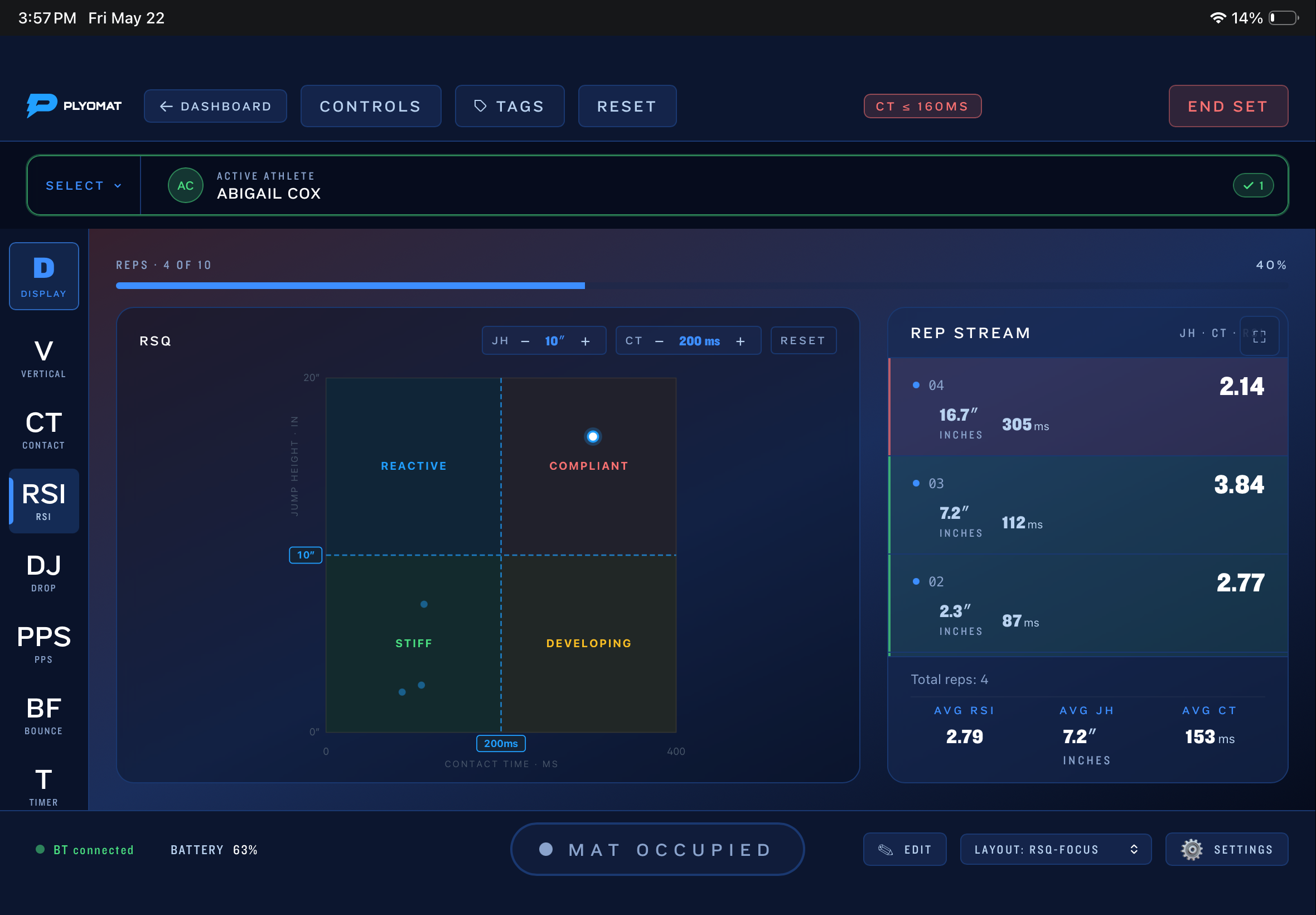
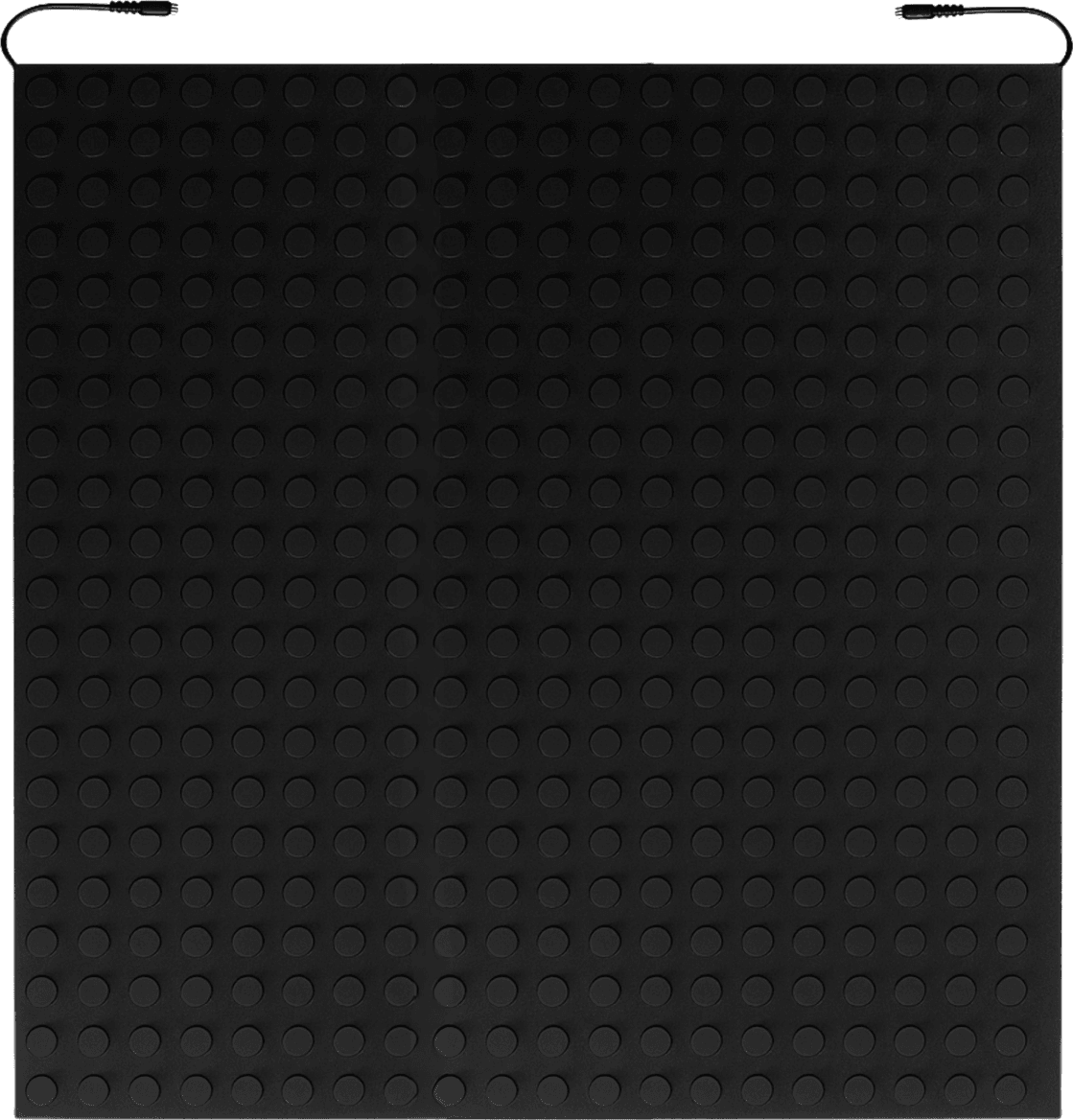
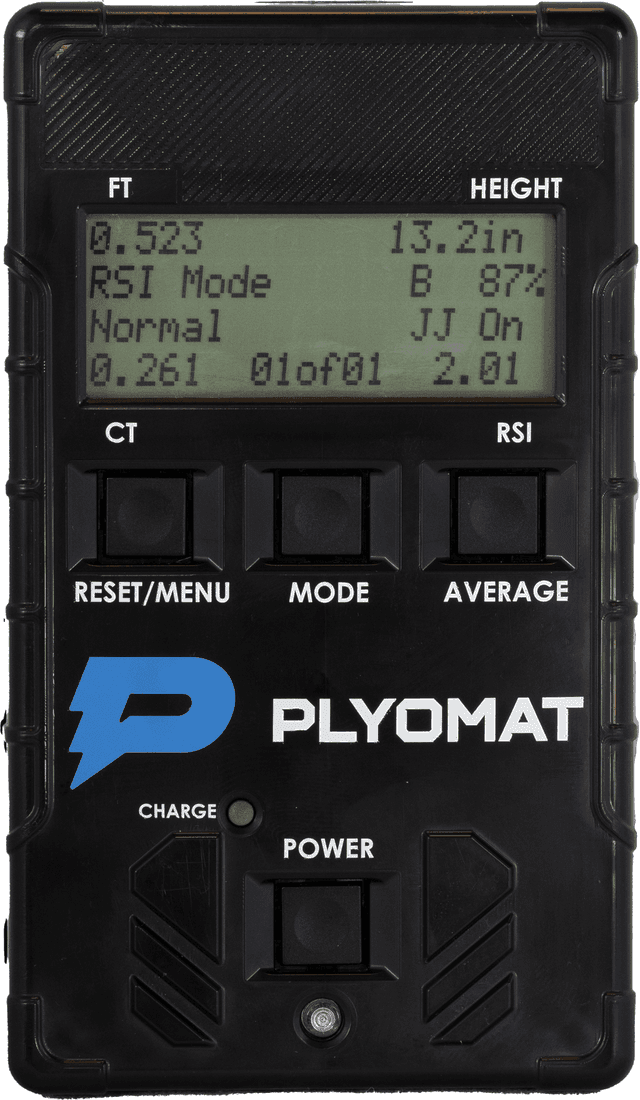
Flight and ground time per rep, RSI live, the quadrant plotted as the set happens.
Runs on the phone or tablet you already own. Sessions sync to the cloud.
Buy the hardware once. The software and your data stay yours.
Tier-based plyometric programming, education, and coaching from Matt and the Plus Plyos team, wherever you train.
Explore programsLab data, field price. Measure every contact, plot every rep on the quadrant, and let the numbers run your progressions.
Buy a Plyomat