A bilateral test cannot answer a unilateral question.
Dual force plates can show how each limb contributes to a bilateral countermovement jump. That is useful bilateral information. But if you need to know how one leg absorbs, stabilizes, and rebounds by itself, the test has to ask that leg to do the job by itself.
In a dual-force-plate CMJ, each leg is measured while both legs share the same task. The athlete can redistribute load, change coordination, and use the stronger side to help solve the movement. That makes the result a view of bilateral strategy, not a direct test of one-leg performance.
What bilateral CMJ can tell you
How the legs share a bilateral jump
Force, impulse, and other measures can be separated by limb while the athlete jumps with both feet. This can flag bilateral force distribution and asymmetry in that specific bilateral task.
What it cannot replace
One-leg output under one-leg demand
It does not directly show how either leg performs when it alone must accept the landing, organize the body, and create the next takeoff. That is a different motor problem and requires a unilateral test.
Bilateral taskSeparate limb curves show how force is shared while both legs are available.Unilateral taskThe leg is responsible for the landing, short contact, and next takeoff.
The practical principle: use a bilateral CMJ to understand a bilateral CMJ. Use a unilateral CMJ, hop, or single-leg drop jump to understand the limb doing that unilateral job. Convenience is not the same as depth.
Test the question
Two questions. Two tests.
Bilateral CMJ on dual plates
Use it when the performance question is bilateral: how does the athlete produce force and distribute it when both legs jump together?
Whole-body jump strategy
Left-right contribution within a bilateral task
Bilateral force asymmetry and trend monitoring
Useful, but task-specific
Unilateral CMJ or reactive test
Use it when the performance question is unilateral: what can this leg do when the other leg cannot assist?
Single-leg jump output and control
Single-leg landing and re-acceleration
Leg-specific reactive strength and contact time
The better match for unilateral return-to-play questions
Why the answer can change
Athletes do not express asymmetry the same way in every task.
That is not a theoretical concern. In professional basketball and volleyball players, bilateral CMJ and single-leg jump testing produced significantly different asymmetry magnitudes. The authors concluded that the tests should not be used interchangeably, but together when both perspectives are needed. A separate reliability study found that unilateral CMJ produced more reliable single-leg performance measures, while bilateral CMJ produced more consistent inter-limb asymmetry scores. Those findings point to a simple conclusion: the two tests are complementary, not substitutes.
This is also consistent with what we see in high-level athletes. In work with NFL Combine athletes, a bilateral jump can look clean while a single-leg task reveals a meaningful difference in one limb's ability to control and rebound. That field observation is not a universal diagnostic rule or a claim about injury risk. It is the reason to test the question directly before you make a one-leg decision from a two-leg task.
Reactive strength is no exception
To isolate unilateral reactivity, test unilateral reactivity.
Reactive strength combines the ability to absorb force and produce the next effort quickly. In a bilateral drop jump or repeated-hop test, both legs contribute to the contact and rebound. You can learn about the athlete's bilateral reactivity, but you have not isolated either leg's reactive capacity.
A single-leg drop jump or a progressed single-leg hopping protocol changes the question. Each leg now owns the landing, the brief ground contact, and the rebound. This is the appropriate testing direction when you want leg-specific contact time, jump outcome, and single-limb RSI. It should only be used with appropriate readiness, a progressive box height, clear technique rules, and familiarization. The research also shows that RSI is sensitive to technique, so consistency in task and instruction is essential.
Do not force a single-leg reactive test just to collect a number. Progress the athlete to it. When the athlete is ready, it gives a cleaner answer to a unilateral reactivity question than a bilateral test ever can.
1
↘
Step off
Begin from a sensible, progressive box height and land on the tested leg.
2
●
Own the contact
One limb manages the landing, position, and brief ground contact without help from the other.
3
↗
Rebound
Measure the outcome and contact time for that leg's reactive response, then repeat on the other side.
Surface area is part of the protocol
Single-leg testing deserves room to land.
More target. More confidence.
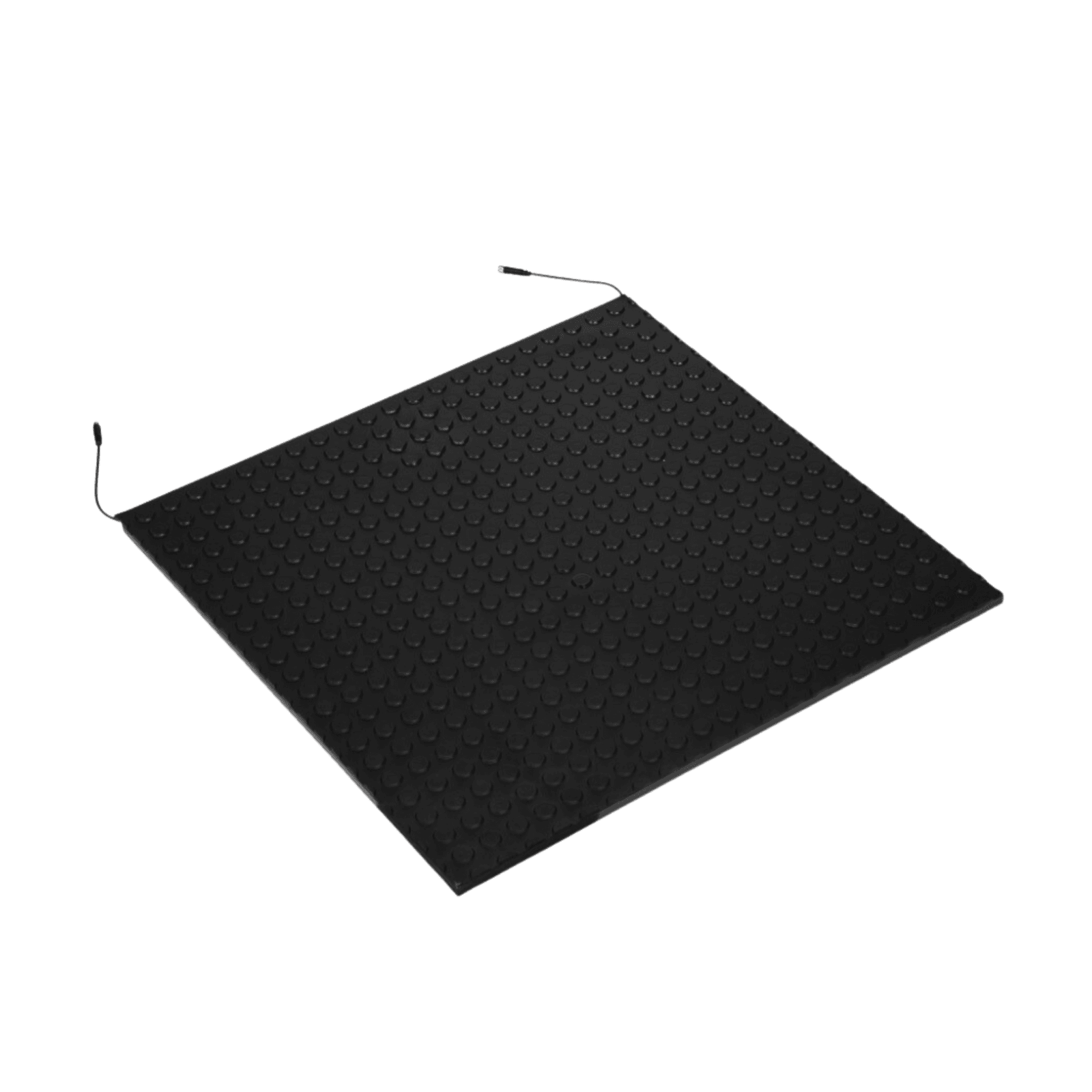
A single-leg rebound requires an athlete to hit, control, and leave the testing surface quickly. On a compact force plate, the small target can change how freely an athlete attacks the task or make the test feel unnecessarily unforgiving. Plyomat's 28 × 28 inch mat gives the athlete a broad, familiar landing target for unilateral jumps and hops.
This is a practical design and testing consideration, not a claim that a larger surface prevents injury. Coaches should still screen readiness, progress exposure, set the right height, and supervise the test.
28 × 28
inches of landing surface on the Plyomat 28 × 28 mat
What the literature supports
Research notes, without overclaiming.
The evidence supports task specificity and careful interpretation. It does not support treating one test as a complete replacement for another.
2025 · Professional athletes
Bilateral and single-leg jumps are not interchangeable
Professional basketball and volleyball players showed significant differences in asymmetry magnitudes between bilateral CMJ and single-leg jumps. The authors recommend using both to understand performance capabilities and asymmetry.
Unilateral CMJ produced more reliable single-leg performance measures for most variables, while bilateral CMJ produced more consistent inter-limb asymmetry measures. Interpret each for what it measures.
Different drop-jump techniques produced different RSI, contact-time, and jump-height values. Standardize the task before you compare an athlete across time or legs.
Research assessing reactive strength has explicitly included single-leg drop jumps and hopping alongside bilateral jumps. The unilateral test is not a bilateral proxy. It is its own task, with its own protocol.
Can dual force plates provide unilateral data during a bilateral CMJ?
They provide each limb's contribution within a bilateral CMJ. That is useful for bilateral force distribution and asymmetry, but it is not a direct measure of how each limb performs alone under a unilateral landing and takeoff demand.
Do bilateral and unilateral jump tests show the same asymmetry?
Not necessarily. Published work in professional athletes found meaningful differences between bilateral CMJ and single-leg jump asymmetry. Use a test for the task you want to understand, then use both when both questions matter.
How should I assess single-leg reactive strength?
With a progressed and standardized unilateral reactive task, such as a single-leg drop jump or repeated single-leg hop. Keep the same setup and coaching cue over time, and only use the test once the athlete is ready for it.
Why use a larger mat for single-leg testing?
It provides a larger, clearer landing target for a demanding one-leg rebound. It is a practical execution and confidence advantage, not a medical safety claim. Coaches should still screen, progress, and supervise the athlete.
Ask the leg to do the job.
Use a full landing surface to test unilateral jump and reactive strength with confidence, then track the metrics that matter.